What Is Temporal Intelligence?
Dec 21, 2025
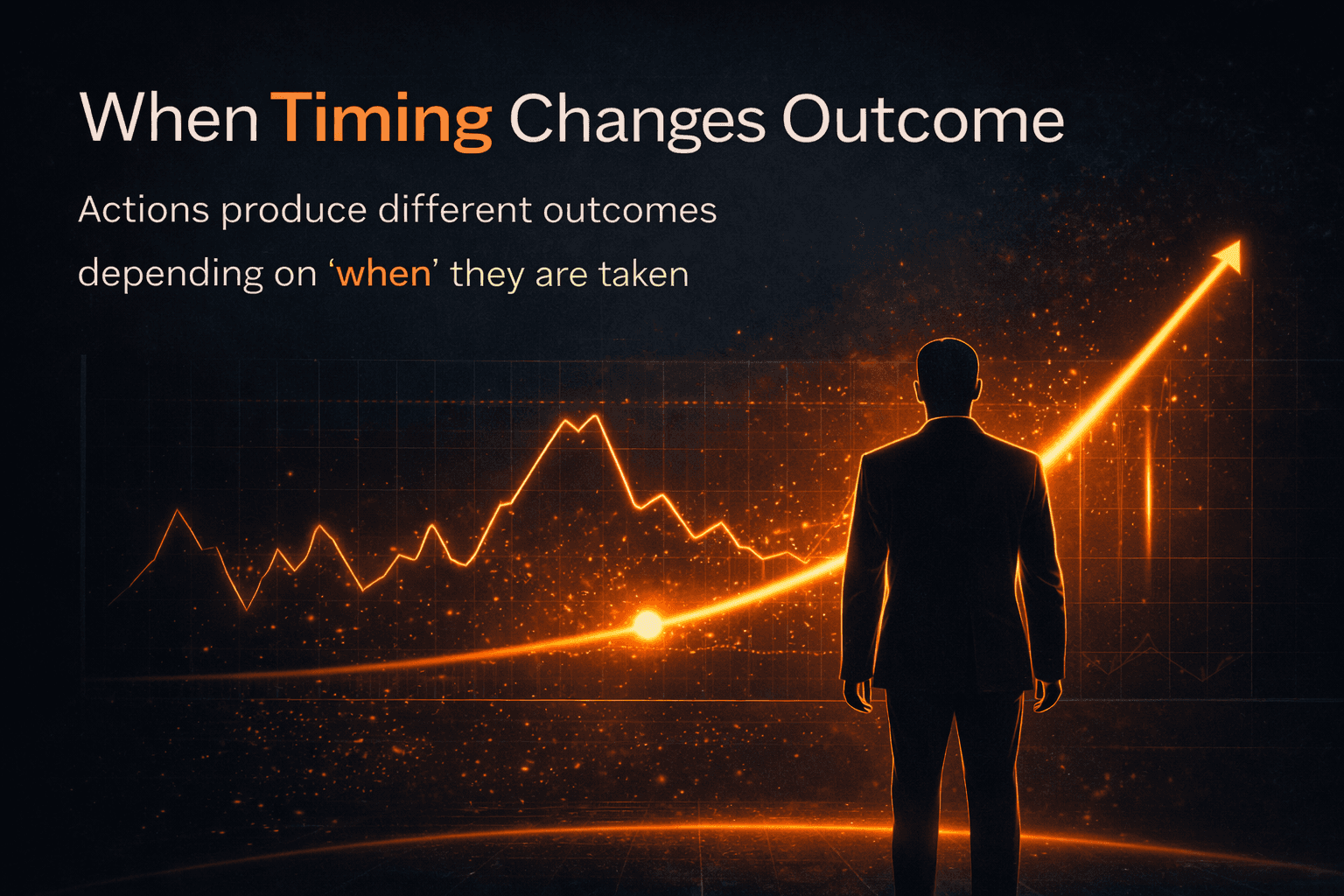
Most people think intelligence is about prediction.
What will happen next?
What is the most likely outcome?
What does the data say about the future?
Temporal Intelligence begins by rejecting that premise.
In complex systems; markets, healthcare, logistics, geopolitics, infrastructure—failure rarely happens because people lacked information. It happens because action was taken at the wrong time. The question is not what will happen, but when is information valid enough to act on.
Prediction assumes a static world where variables behave consistently. Real systems are dynamic. They expand, compress, stall, recover, and realign. In these environments, meaning is not fixed—it is time-dependent.
The same dataset can be:
correct but useless
accurate but dangerous
insightful but premature
Without understanding when conditions are receptive, information becomes unstable. This is why well-researched strategies fail, why accurate forecasts underperform, and why “being right” so often leads to poor outcomes.
Temporal Intelligence reframes decision-making away from guessing outcomes and toward reading readiness. It focuses on how systems behave across time:
alignment between long and short horizons
buildup and release of pressure
delays between cause and effect
synchronization across layers of activity
Rather than asking “What will happen?”, Temporal Intelligence asks:
Is the system ready?
Are conditions aligned?
Is action supported by time, or resisted by it?
The future is not something to predict. It is something that unfolds when conditions are ready.